The Customer Left. Could Your Business Have Seen It Coming?
Customers rarely decide to leave overnight. The data often reveals the warning signs much earlier - before the final decision is ever made.
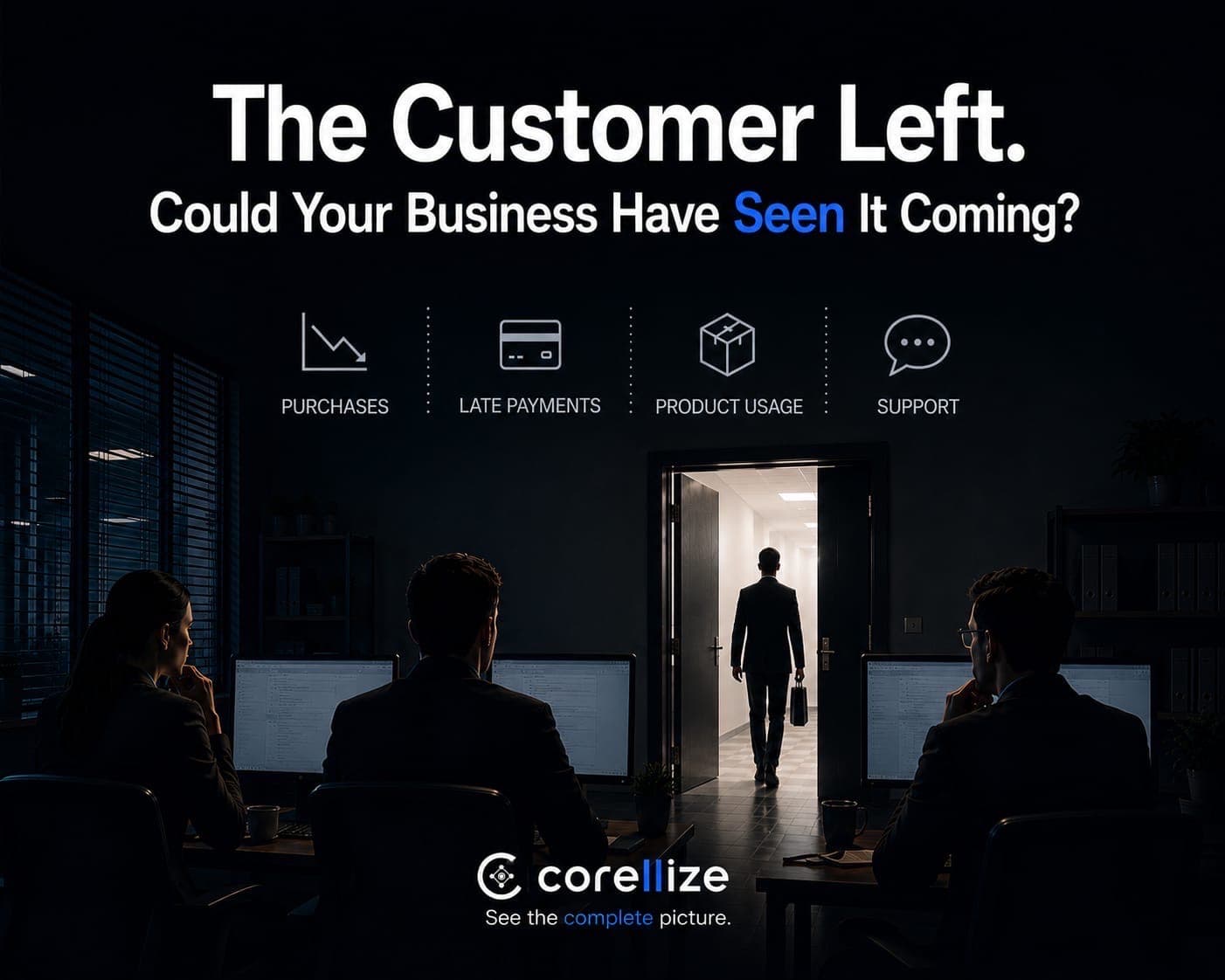
The customer informs you that they've chosen another supplier.
Management is surprised.
The sales team says, "Everything seemed fine."
Situations like this are common. Yet customers rarely decide to leave overnight. The data often reveals the warning signs much earlier. Before the final decision is made, customer behavior usually starts to change in small, almost unnoticeable ways.
Imagine a customer who has worked with your company successfully for five years. For years, they placed orders every month. Over the last three months, orders become less frequent, invoices are paid later than usual, the customer support team receives more questions, and product usage gradually declines.
Individually, these signals seem insignificant.
Together, they tell a very different story.
This is where companies often make one of their most expensive mistakes - they fail to recognize a customer they still had the opportunity to retain.
Losing an existing customer means investing in marketing, sales, and building new customer relationships all over again. Those are resources that could have been invested in growing the business instead.
Why Do the Signals Go Unnoticed?
After a customer leaves, companies often ask themselves one question: What did we miss?
In many cases, all the necessary signals were already there.
They were simply spread across different systems.
- The sales team followed the customer's purchasing history.
- Finance tracked payment behavior.
- Customer support saw an increase in questions and complaints.
- Product usage data showed declining engagement.
Each team saw its own part of the process.
No one saw the complete picture.
This situation is commonly described as data silos. Information is stored across different systems and departments, making it difficult to identify trends early and make well-informed business decisions. IBM explains the impact of data silos on organizational decision-making in What Are Data Silos?
Early Recognition - A Financial Advantage
Research on customer retention also highlights the financial value of identifying risks early. Bain & Company found that increasing customer retention by just 5% can increase profits by 25% to 95%, a finding also referenced by Harvard Business Review in The Value of Keeping the Right Customers. It demonstrates that recognizing risks early helps companies retain customers and reduces the need to repeatedly invest in acquiring new ones.
Conclusion
A customer leaving is usually the final stage of a process that began much earlier.
Changes in customer behavior are often visible long before the customer decides to leave.
The real challenge is bringing those signals together into a single view.
Only then can a business make decisions while there is still time to retain the customer, rather than trying to understand why they left after the fact.
That is why more organizations are creating a unified view of customer data by combining information from sales, finance, customer support, and other business systems. Seeing the complete picture makes it possible to make timely, informed business decisions.
Sources
- Harvard Business Review - The Value of Keeping the Right Customers
- IBM - What Are Data Silos?
- Bain & Company - Loyalty Rules!
Ready to automate your sales process?
Let's map your workflow and identify where automation creates the fastest measurable impact.
Book a Call