What Changes When AI Agents Start Exchanging Enterprise Files?
AI agents do not change the fundamentals of secure file exchange. They change the identity, speed, scale, and autonomy of the actor initiating each action.
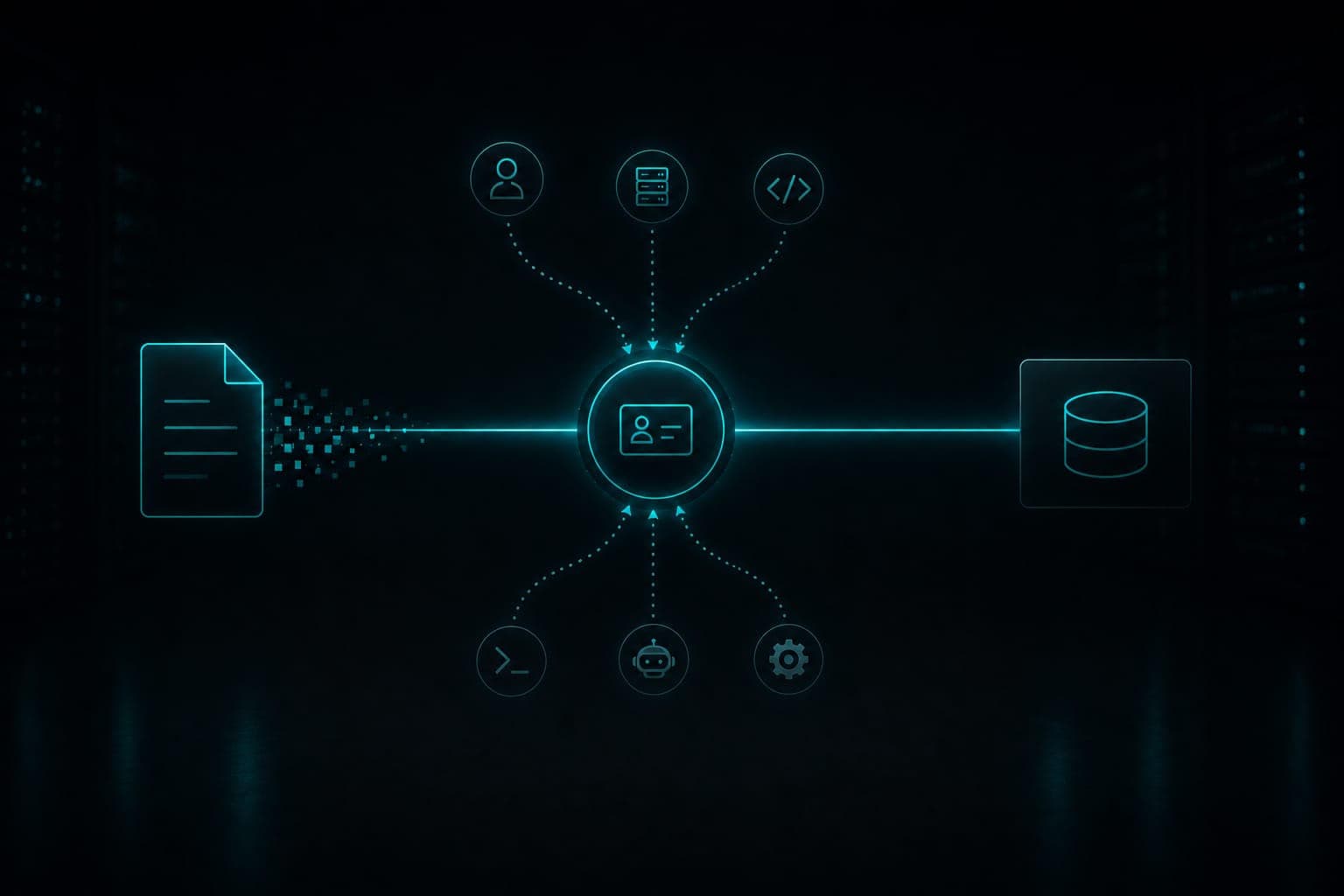
A file leaves an enterprise system. No employee clicked "Send." An AI agent retrieved it, processed it, selected the destination, and initiated the transfer. The file may have followed every technical rule. It may have been encrypted. The connection may have succeeded.
But a new question appears: Who actually performed the action?
For years, enterprise file exchange has been built around relatively predictable actors: employees, partners, service accounts, and configured system integrations. AI agents change that model. They can act independently, call multiple systems, retrieve information, make decisions, and initiate actions without a person approving every individual step.
The security principles haven't changed. The identity behind the action has.
What Happens When the Requester Is No Longer a Person?
Traditional access models usually start with identity. A user authenticates. A partner has an account. A system integration uses a certificate, key, or service identity. Permissions are then attached to that identity.
AI agents complicate this because an agent may act on behalf of a person, a department, another system, or even another agent.
Consider an agent responsible for processing supplier documents. It receives an invoice, checks information against an ERP system, determines which workflow it belongs to, and sends the document to another system or external partner. Several actions may happen without anyone manually touching the file.
The important question is no longer simply: "Which user sent it?"
It becomes: "Which identity initiated this action, on whose authority, and what exactly was it allowed to do?"
Without a distinct and verifiable identity, those questions become difficult to answer.
Why Are Shared Credentials a Problem for AI Agents?
Automation has always used machine credentials. Service accounts, API keys, certificates, and integration users are nothing new. The problem appears when multiple automated actors operate through the same identity.
Imagine five agents using one API key to access a document repository. One downloads a contract. Another retrieves a customer file. A third sends information to an external system. The audit log records the same credential every time. Technically, the system knows which credential was used. Operationally, it may still be impossible to determine which agent actually performed the action.
That distinction matters when something goes wrong. If an agent retrieves a file it shouldn't have accessed, security teams need to know whether the problem came from the agent's permissions, its instructions, another system acting through the same credential, or a compromised credential.
A shared identity makes those possibilities much harder to separate.
What Does This Change for the File Itself?
Very little about the file. A great deal about the controls surrounding it.
An AI agent requesting a file should have to establish trust just as any other actor would. Its identity should be verifiable. Its access should be limited to the systems, folders, or data required for its task. The transfer should still be encrypted. And the action should leave enough evidence to reconstruct what happened later.
That means a useful audit trail increasingly needs to answer more than: "Which file moved, and when?"
It may also need to answer: Which agent initiated the transfer? Under whose authority was it operating? Which identity authenticated? What was it permitted to access? Where did the file go?
This becomes especially important as agents begin chaining actions across several enterprise systems. One request can trigger another, which triggers another. Without distinct identities and traceable actions, the audit trail can quickly become a record of systems talking to systems without clearly showing who was responsible for each decision.
Are Enterprise Access Controls Ready for This?
The early evidence suggests there is still a significant gap. IBM's 2025 Cost of a Data Breach Report found that among organizations reporting an AI-related security incident, 97% lacked proper AI access controls. IBM also found that 63% of breached organizations either lacked an AI governance policy or were still developing one.
That doesn't mean AI caused those incidents. It points to a different problem: AI capabilities are being connected to enterprise data faster than the controls around those connections are being defined.
For file exchange, that distinction matters. An agent doesn't need unrestricted access to an entire document repository simply because one workflow requires it to retrieve a particular file. The same principle already used for human users and external partners still applies: Give the identity access to what it needs - not everything the surrounding system can reach.
The difference is that machine-driven actions can happen far more frequently and without a person watching each one.
What Should Change Before Agents Start Moving Files?
The answer isn't to create an entirely new security model for AI. It is to apply existing security principles more precisely to non-human actors.
- Each agent or automated workload that can initiate sensitive actions should have an identity that can be distinguished from others.
- Permissions should be scoped to its actual task.
- Credentials shouldn't be shared simply because several agents belong to the same workflow.
- File transfers should remain encrypted and controlled regardless of whether they were initiated by a person, an integration, or an agent.
- And every action should produce enough evidence to determine what happened afterward.
The goal is simple: Automation shouldn't make accountability disappear.
So, What Changes When AI Agents Start Exchanging Enterprise Files?
The fundamental requirements don't. Identity still matters. Least privilege still matters. Encryption still matters. Auditability still matters. What changes is the scale, speed, and autonomy of the actor using them.
When a person sends ten files, there are ten deliberate actions. An agent may initiate hundreds or thousands of actions as part of a workflow without anyone reviewing each one individually. That makes identity and traceability more important, not less.
Soon, asking "Who sent this file?" may no longer be enough.
The more useful question will be: Was it a person, a system, or an AI agent - under whose authority did it act, and can you prove it?
Ready to automate your sales process?
Let's map your workflow and identify where automation creates the fastest measurable impact.
Book a Call